SpaceX IPO: 3 Days, $1.18 Trillion — What Retail Investors Need to Know
I’ve watched a lot of IPOs. I’ve also made a lot of IPO mistakes — the kind where you stare at your portfolio the next morning and wonder what exactly you were thinking at 11:47 AM the day before.
The SpaceX IPO is not like anything I’ve seen.
Three trading days. A 67% surge. $1.18 trillion in market cap added — roughly the equivalent of conjuring an entire Netflix out of thin air, four times over. By June 16, SpaceX stock briefly kissed a $3 trillion valuation, passing Amazon and momentarily edging past Microsoft to become the world’s fourth-largest company. Four days earlier, this company wasn’t even public.
The numbers are so large they stop making sense. So let me break down what actually happened — the mechanical reasons, the blueprint Musk is selling, the capital-markets flywheel hiding in plain sight, and the structural risks that can turn IPO excitement into a very expensive education.
Table of Contents
What Just Happened
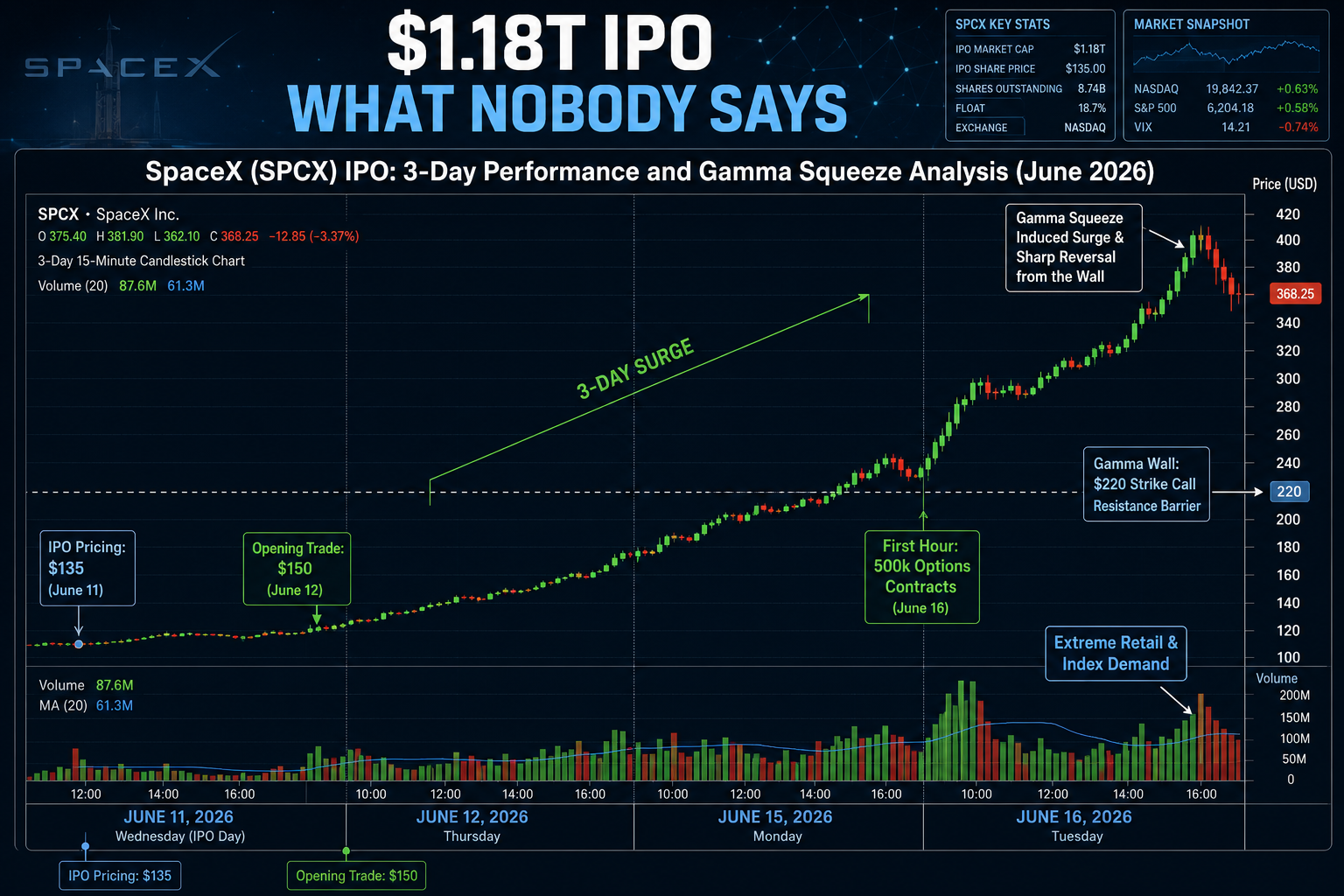
SpaceX priced at $135 per share on June 11, raising $75 billion — more than double the previous IPO record set by Saudi Aramco in 2019. It opened at $150 on June 12, hit $176 intraday, and closed at $161. By Monday June 15, it added another 20%. By Tuesday June 16, the stock touched $225.64 before reversing sharply to close at $201.80.
Here’s the number that stuck with me: according to Vanda Research, in those first two trading days, retail investors poured $2.25 billion into SpaceX stock — and that represented 75% of all single-stock retail net buying in the entire U.S. market. For every $4 retail investors put into individual stocks, $3 went into SpaceX. I’ve never seen anything close to that concentration.
Most of those retail buyers never got the $135 IPO price. They entered at $150, $170, $200. And most of them, if you read the interviews on CNBC and Business Insider, knew the valuation was stretched. They bought anyway.
One investor, a 51-year-old veterinary executive named Marvin Jung, told a reporter the valuation was “absurd, stupid, irrational” — while submitting a 1,000-share order on Robinhood. That’s not hypocrisy. That’s FOMO in its purest form.
The 3 Mechanical Reasons Behind the Surge
This rally wasn’t about SpaceX suddenly getting better at rockets last week. It was about supply, demand, and derivatives — in that order.
1. The float is microscopic. Only about 4% of SpaceX’s total shares are publicly tradable. The other 96% are locked up with insiders, employees, and early investors. When global demand — built up over 24 years of waiting to buy SpaceX — finally met a market with almost no shares available, price disconnected from fundamentals. What you’re looking at is a scarcity price, not a fair value price. The same company, same revenue, same outlook — but when only one out of every 25 shares can actually trade, every buy order hits the tape harder than it normally would.
2. Gamma squeeze mechanics kicked in immediately. Options on SPCX began trading June 16. In the first hour alone, 500,000 contracts changed hands. Calls outpaced puts roughly 1.7 to 1. Here’s what that actually means: when market makers sell call options, they have to buy the underlying stock to stay delta-neutral. As the stock rises, the delta on those calls increases — so they have to buy more. More buying pushes the stock higher, which increases delta further, which forces even more buying. That’s a gamma squeeze — a mechanical, self-reinforcing feedback loop that has nothing to do with whether SpaceX is worth $135 or $225. SpotGamma called it “one of the highest-gamma-sensitivity environments of the decade.”
3. Passive index funds are queued to buy, no matter the price. Nasdaq fast-tracked SpaceX into the Nasdaq-100 after just 15 trading days, waiving the standard 3-month waiting period. Russell inclusion follows on June 26, MSCI on June 29. Every index-tracking ETF must buy SpaceX at its index weight — regardless of valuation. Market estimates put the forced buying at $220-270 billion. Into a float where almost nobody is selling, because 96% of shares are still locked.
These three forces created something that looks like a fundamental bull run but isn’t. My honest opinion: if you don’t understand these mechanics, you’re gambling on supply and demand dynamics you can’t see. And the same gamma loop that amplifies upside can accelerate a reversal — which is exactly what happened when SPCX hit $225.64, encountered a gamma wall at the $220 strike, and reversed to $201.80 within hours.
The Blueprint Musk Is Actually Selling
On June 8, four days before the IPO priced, Elon Musk stood in a Texas satellite factory and laid out a vision. He wasn’t talking about rockets or Mars. He was talking about the Kardashev scale — a 1964 framework by Soviet physicist Nikolai Kardashev that ranks civilizations by how much energy they harness.
Type I uses all the energy on a planet. Type II uses all the energy of a star. Humanity isn’t even at Type I yet. Musk’s words: “We are not even registered.” He pointed out that the Sun contains 99.86% of all mass in the solar system, and humanity currently captures less than one-trillionth of its output. Reaching even one-millionth, he said, would be “an epic, epic achievement” — he used the word “epic” twice for emphasis.
Then he drew the line connecting this 60-year-old physics concept to SpaceX’s actual product: orbital AI data centers.
The logic is surprisingly straightforward. On Earth, building an ai data center means fighting two brutal bottlenecks — electricity that grids can’t supply fast enough (20% of new U.S. power demand already comes from AI alone), and cooling systems that consume massive energy just to stop chips from melting. In space, the Sun provides near-unlimited solar power with no cloud cover, no night cycle. And radiative cooling in a vacuum is simpler — you just dump heat into space rather than pumping water through elaborate systems.
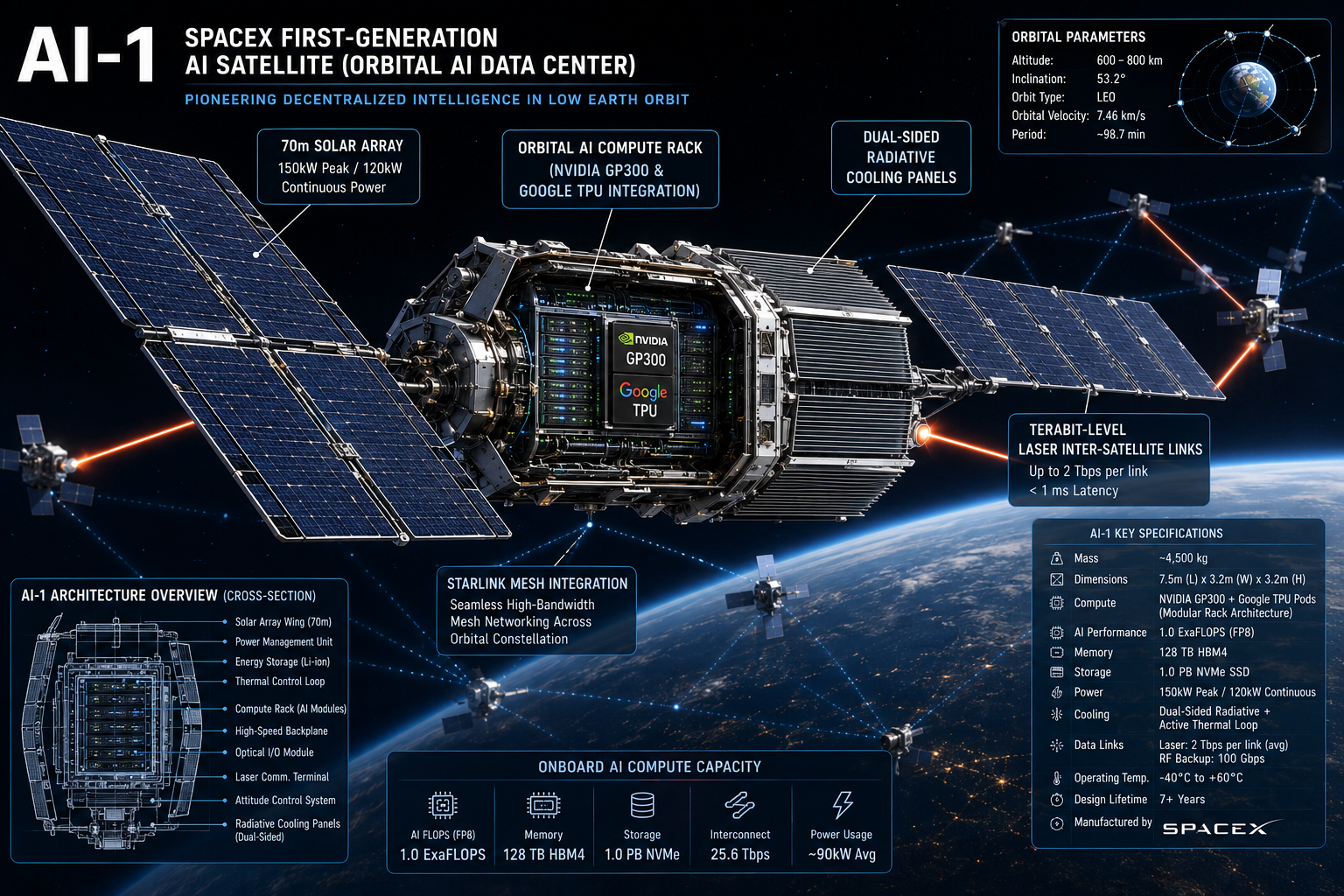
SpaceX’s first-generation AI satellite, called AI-1, is designed for 150 kilowatts peak power and 120 kilowatts continuous — roughly one NVIDIA GPU server rack, floating in orbit with a 70-meter solar array wider than a Boeing 747. Orbit altitude: 600 to 800 kilometers. Data latency to Earth at light speed: about 3 milliseconds per hop. As Musk put it, “Light moves pretty fast.” Inter-satellite links run at terabit-level bandwidth via laser, connecting each AI-1 into a mesh network that links back to the existing Starlink constellation.
The four-step timeline he laid out: 1 gigawatt of orbital AI compute by end of 2027. 10 GW within two and a half years. 100 GW within three and a half years. The ultimate target: 1,000 GW — one terawatt. For reference, the entire United States consumes about 500 GW. Musk wants to put twice that into orbit.
Getting there requires three things, all specified in the interview: launch capacity (Starship, targeting 100 tonnes to orbit per flight at hourly cadence), power (the Sun), and chips. On chips, the global AI chip industry produces roughly 100 GW of compute per year. Musk’s answer to bridging the gap: TerraFab, a planned 1-billion-square-foot chip factory — ten times the size of Tesla’s Giga Texas — designed to produce the equivalent of one billion chips’ worth of compute annually. He also mentioned adapting the design for Google TPUs alongside NVIDIA’s GP300 and Rubin architectures.
And for what comes after the terawatt era? Lunar factories. Musk’s endgame: manufacture solar panels and radiator fins on the Moon — where gravity is one-sixth of Earth’s and there’s no atmosphere — then launch finished AI satellites into orbit using electromagnetic mass drivers instead of rockets. He added, almost as an aside: “Everyone should go to the Moon at least once.”
This is what Wall Street is buying. Not today’s $18.7 billion in revenue. Not the $4.9 billion net loss. The future. The spacex valuation debate ultimately comes down to whether you believe this blueprint converts into reality — and on what timeline.
I’ll say this: I’ve never seen a company lay out a vision this specific. Most CEOs give you a mission statement and a wink. Musk gave you satellite power specs, radiator surface area, gigawatt-per-year growth gradients, TerraFab square footage, and a lunar manufacturing roadmap. Morningstar assigns a $63 fair value estimate — less than half the IPO price — because their model prices today’s business. Wall Street is pricing the blueprint, not the income statement. Those are two completely different things.
The Flywheel Nobody Noticed: Vision → Stock → Acquisition Currency
Here’s the part most coverage missed. On June 16 — the same day SPCX peaked at $225 — Musk announced SpaceX would acquire Cursor, the AI coding assistant used by 64% of Fortune 500 companies, for $60 billion. The purchase price: zero dollars in cash. The entire deal was paid for with newly issued SpaceX stock — stock that had surged 67% in three days.
This is not a side note. This is the strategy.
Cursor, built by Anysphere (founded 2022 in San Francisco), had reached $2.6 billion in annualized B2B revenue and a $29.3 billion valuation in its last private round. Its market share had actually slipped — from 41% to 26% over the past year — as Anthropic’s Claude Code and OpenAI’s Codex ate into its lead. But that’s not why Musk bought it. He bought it because Cursor brings an enterprise customer network and an AI coding product that, when merged with xAI’s Grok models (trained on the Colossus supercomputer cluster in Memphis), creates an end-to-end AI ecosystem: chat AI, coding AI, and orbital compute — all under one roof.
The deal structure is where the genius lives. SpaceX had already signed an option agreement with Cursor back in April, before the IPO even priced. The terms: either a $60 billion all-stock buyout, or a $10 billion breakup fee that converted into a deep partnership. Either way, SpaceX wouldn’t walk away empty-handed. And by executing after the stock surged, the same $60 billion acquisition cost only 3.2% in dilution to existing shareholders.
This is a flywheel. Use the vision (Kardashev scale, AI satellites, lunar factories) to drive stock valuation. Use the inflated stock as acquisition currency to buy real businesses with real revenue. Use those businesses to strengthen the vision. Repeat. And while the rockets aren’t yet putting AI satellites in orbit, Musk is already monetizing ground-based compute — SpaceX just signed cloud leasing deals with Anthropic and Google worth roughly $260 billion annually in total contract value, renting out idle GPU capacity to the very companies whose AI coding tools compete with Cursor.
I’ve covered capital markets for years. I have never seen anyone execute this particular sequence — IPO → gamma squeeze → all-stock acquisition → competitor cloud deal — with this level of coordination. Whether you think it’s genius or a house of cards, you need to understand that the stock price is not just an output of the business. It is an input into the strategy.
Insider Strategies Most Retail Investors Miss
Strategy 1: The lockup calendar is your actual edge.
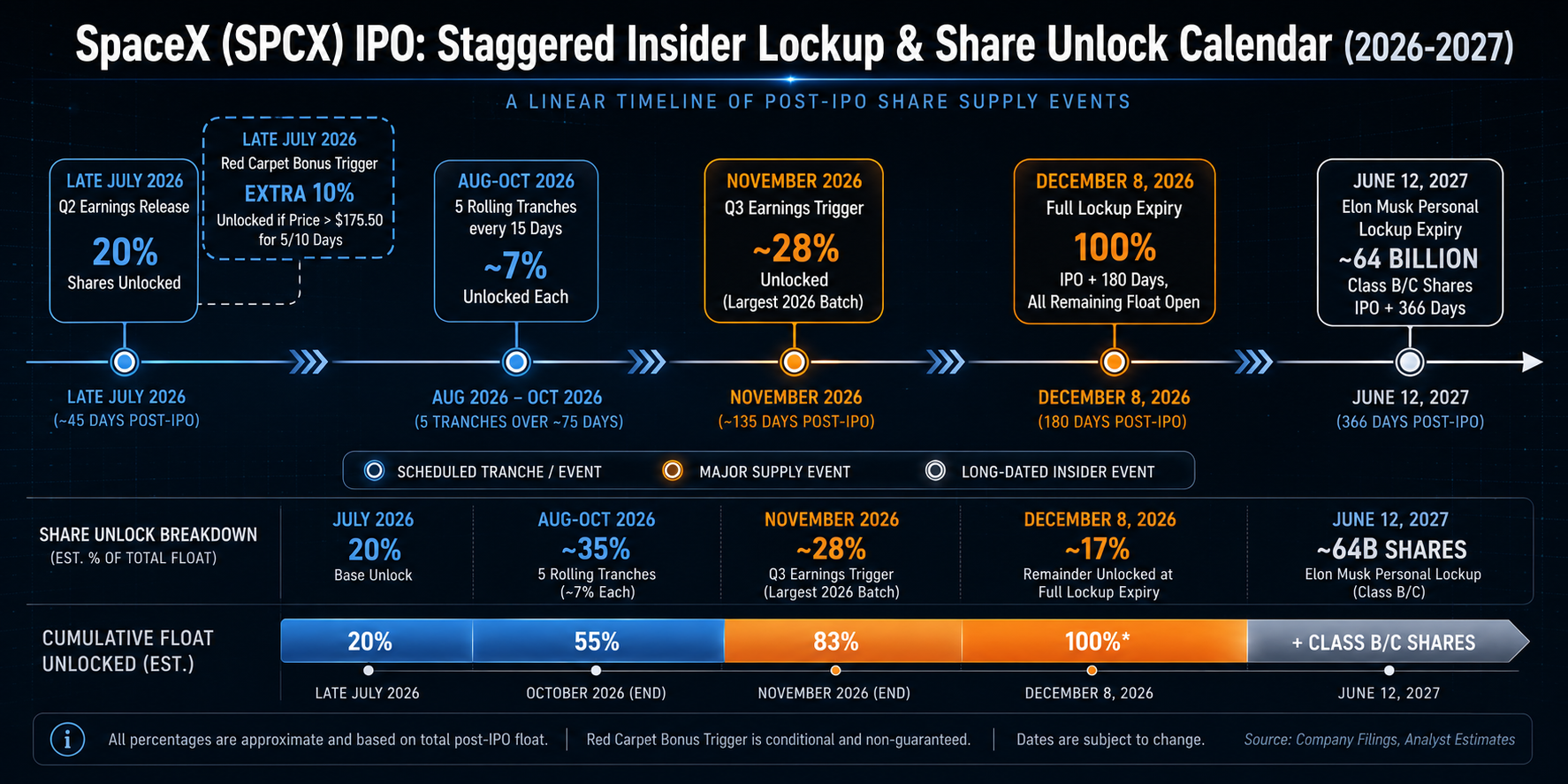
Most people assume insiders can’t sell for 180 days. SpaceX didn’t do a standard lockup. They negotiated a staggered release, and the S-1 spells out every window:
| Date Window | Event | Shares Unlocked |
|---|---|---|
| Late Jul 2026 | Q2 earnings + 2 business days | 20% of insider shares |
| Late Jul 2026 | If SPCX holds above $175.50 for 5 of last 10 trading days | Additional 10% “Red Carpet” bonus |
| Aug-Oct 2026 | Rolling tranches every 15 days (5 windows) | ~7% each |
| Nov 2026 | Q3 earnings trigger | ~28% (largest single batch) |
| Dec 8, 2026 | Full lockup expiry (IPO+180) | All remaining shares |
| Jun 12, 2027 | Elon Musk’s personal lockup (IPO+366) | ~64 billion shares |
The first real test doesn’t come in December. It comes in late July, when employees and early VCs get their first sell window. Track the Q2 earnings date. Track the $175.50 trigger — it’s a binary catalyst. If the stock holds above that level for 5 of the last 10 trading days before earnings, an extra 10% of shares unlock immediately. If it doesn’t, those shares get pushed to December, concentrating supply into the year-end cliff.
Also worth noting: Musk himself cannot sell a single share until June 2027. The selling pressure this year comes from employees and early investors, not from Musk. That distinction matters.
Strategy 2: The gamma squeeze cuts both ways — and 101% IV makes options a brutal trade.
When SPCX hit $225.64 on June 16, it ran into a gamma wall at the $220 strike — the most popular call contract. Dealers short those calls had to sell into every tick higher to manage their hedges. The stock reversed to $201.80 within hours. The same mechanics that amplify upside also cap it and can accelerate a selloff. And at 101% implied volatility, theta decay is eating option premiums alive — you need the stock to move fast and in your direction just to break even.
Strategy 3: The float math is changing, week by week.
The 67% three-day gain happened under extreme artificial scarcity — 4% float. By year-end, with staggered unlocks, the float could expand to 15-20%. By December 8, everything except Musk’s shares is fully unlocked. Every expansion changes the supply-demand equation that created the surge. Six separate unlock windows between now and year-end. Each one is a supply event.
4 Mistakes That Can Cost You Real Money
Mistake 1: Buying on day one without understanding the float.
I’ve done this. You watch a stock rip from $150 to $176, your heart is pounding, you hit buy at $170, and by close it’s $161. You’re down $900 in three hours, staring at a red number on your screen, and the feeling is a mix of shame and disbelief — how did I let myself do that again? The price you see on IPO day is a scarcity price. The same company, same fundamentals, same outlook — but the tradable float could be 5x larger by year-end. Price discovery under extreme float constraint is not fair value.
Mistake 2: Trading based on Tesla regret instead of SpaceX math.
A business owner named Mikey Moran told reporters he sold Tesla in 2018 after just weeks and watched it rise 1,700% without him. His logic for buying SpaceX: “It’s hard to bet that Musk will lose.” I understand that feeling viscerally. But here’s the math: Tesla IPO’d in 2010 for $17 per share (split-adjusted ~$1.13) — almost nobody believed in EVs, so the stock had massive room to run as the story played out. SpaceX debuted at $135 with a $1.77 trillion valuation. The market already believes. The asymmetry is structurally different. Don’t let Tesla trauma drive your SpaceX position sizing.
Mistake 3: Ignoring broker flipping restrictions — and the IPO pipeline.
A practical detail most people discover too late: Robinhood imposes a 30-day hold on IPO shares. Sell early, get banned from future IPOs for 60 days. Fidelity escalates from a 6-month ban to a lifetime ban tied to your SSN after three violations. Charles Schwab is the sole major broker with no restrictions. This matters enormously because OpenAI and Anthropic have both filed with the SEC and are expected to IPO later in 2026. Selling SpaceX early to cut a loss could lock you out of both. Check your broker’s policy before you buy, not after.
Mistake 4: Confusing a great company with a great stock at this price.
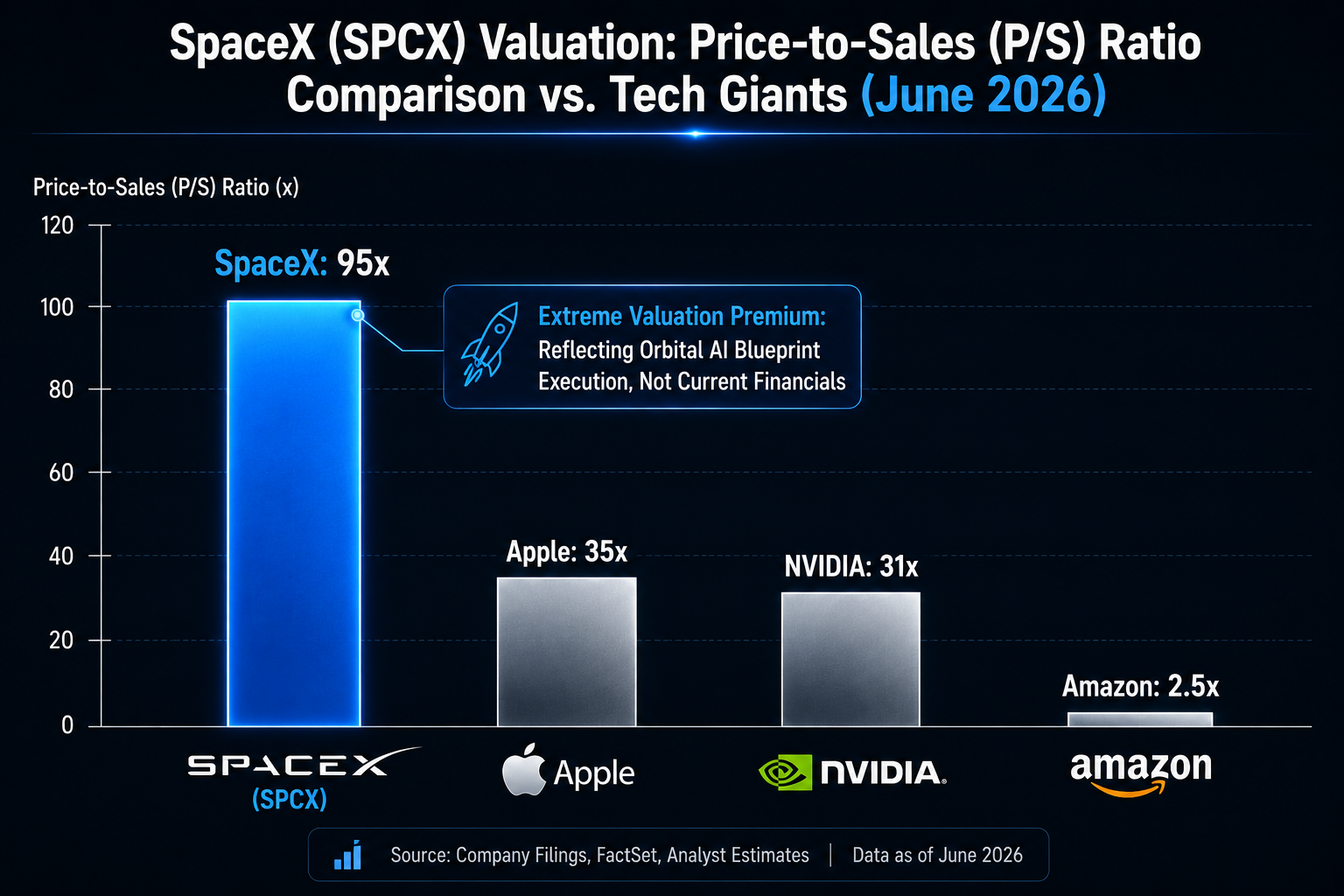
SpaceX has a near-monopoly on orbital launch. Starlink has 10.3 million subscribers and is the only profitable segment. Starship V3 already has double the thrust of the Saturn V moon rocket. All true. And at ~95x price-to-sales — compared to NVIDIA at 31x and Apple at 35x — every future success is already priced in, and then some. Facebook was a genuinely great company in 2012. The stock still fell 29% in two weeks and took months to recover because the IPO was overpriced. Adding to the structural concern: SpaceX uses a dual-class share structure. Your Class A shares on the open market carry minimal voting power — Musk controls over 80% of the vote through Class B shares. You’re buying a ticket to the show, not a vote on the script. The product can be extraordinary and the stock can still be a bad deal at the wrong entry price.
FAQ
Is SpaceX stock overvalued at the IPO price?
By conventional metrics, yes — 95x price-to-sales with a $4.9 billion net loss in 2025. Independent analysts at Morningstar estimate fair value around $63 per share, less than half the $135 IPO price. But the market is pricing in an AI satellite data center network that doesn’t exist yet, Starship launch capacity still under development, and a terawatt-scale orbital compute roadmap that Musk himself frames in decades. The spacex valuation is a bet on blueprint execution, not current fundamentals. Whether that bet pays off depends entirely on timeline and execution — two things the stock price currently assumes will go perfectly.
When can SpaceX insiders sell their shares?
The first window opens in late July 2026, two business days after Q2 earnings — up to 20% of insider shares unlock, with an additional 10% if SPCX closes above $175.50 for 5 of the last 10 trading days before the earnings date. Then rolling 7% tranches every 15 days through October, ~28% after Q3 earnings in November, and full expiry on December 8, 2026. Elon Musk’s personal lockup (approximately 64 billion shares across Class B and performance-linked Class C) does not expire until June 12, 2027 — a full 366 days after the IPO.
What is the Kardashev scale and why did Musk bring it up before the IPO?
A 1964 framework by Soviet astronomer Nikolai Kardashev that measures civilization by energy capture. Type I harnesses all planetary energy (humanity is roughly at 0.7). Type II harnesses all stellar energy — the entire output of a star. Musk’s argument, laid out in his June 8 satellite factory interview: humanity captures less than one-trillionth of the Sun’s output, and reaching even one-millionth would be “an epic, epic achievement.” The AI satellite program is framed as humanity’s first meaningful step toward Kardashev Type II — capturing solar energy directly in space where it’s unlimited and unobstructed. That’s the philosophical architecture behind the entire business plan.
Why did SpaceX stock surge 67% in three days?
Three structural reasons, none of which involve SpaceX’s business suddenly improving: (1) only 4% of shares are publicly tradable — extreme scarcity meets two decades of pent-up global demand; (2) gamma squeeze from record options volume (500,000 contracts in the first hour, 1.73 million on day one) forcing dealers to buy stock to hedge short call positions; (3) passive index funds queued to buy an estimated $220-270 billion for Nasdaq-100, Russell, and MSCI inclusion. This is a supply-demand mechanical event, not a fundamental re-rating.
How does this compare to Facebook’s 2012 IPO?
Both were among the most hyped IPOs in history. Both had extreme valuations relative to current earnings. Facebook priced at $38, opened with massive technical problems on the Nasdaq, and fell 29% to below $27 within two weeks — despite being an extraordinary business. It eventually became a spectacular long-term investment from those post-IPO lows. The key difference: Facebook IPO’d at roughly 100x earnings with slower growth; SpaceX is debuting at roughly 95x revenue (not earnings) with a $4.9 billion net loss, faster revenue growth, a staggered lockup structure that creates multiple supply events, and dual-class shares that concentrate control. Both demonstrate the same core lesson: a great company and a great stock at a given price are two completely different things.
Related: SpaceX IPO: 3 Events That Reveal Who This Market Is Built For — the pre-IPO analysis that set the stage for everything above. And if you’re trying to understand the broader AI landscape, read AI’s Biggest Risk Isn’t a Bubble — It’s an Iron Curtain.
Final Thoughts
Here’s what I actually think. Not as a forecaster — nobody can predict this stock’s next move — but as someone who has studied enough market structures to know what to watch.
SpaceX is an extraordinary company. Its launch monopoly is real — Falcon 9 and Falcon Heavy handle 85-90% of global orbital payload. Starlink has 10.3 million subscribers and is the only segment generating operating profit. The AI satellite vision — terawatt-scale orbital compute, solar-powered, vacuum-cooled, linked by laser mesh — is genuinely unlike anything else being attempted at this scale. The Cursor acquisition, paid for entirely with surging stock, shows Musk already weaponizing the post-IPO valuation as strategic currency.
But paying 95x revenue for a company that lost $4.9 billion last year — and carries dual-class shares giving you effectively zero voting power — is not investing in the company. It’s investing in the belief that the market will keep assigning these multiples while a multi-decade blueprint converts to reality, quarter by quarter, through a series of lockup expirations that will progressively test whether the current price reflects genuine fundamental demand or float scarcity.
The market used three trading days to assign a $3 trillion valuation. Musk has been building toward this for 24 years — from three consecutive failed launches and near-bankruptcy in 2008 to today. The gap between those two timeframes is where the risk lives. The Q2 earnings report in late July is the first real moment of truth — the first time we see segment-level financials as a public company, and the first time insiders can sell.
Markets like this move fast — the earnings date, the $175.50 Red Carpet trigger, the Nasdaq-100 inclusion window, the gamma levels shifting day to day. A friend of mine runs a small Telegram channel where he tracks this kind of market structure as it unfolds, no hype, just observations. If you’re trying to make sense of the noise, it’s worth a look: here
I’m not telling you to buy or sell SpaceX. I’m telling you to understand what you’re actually buying — and what window you’re buying it in.