
I’ve spent the last few months watching investors argue about the same question: is the AI bubble about to burst?
It’s the wrong question entirely.
I get why people ask it. The numbers are genuinely unnerving. Right now, 13% of the S&P 500 trades above 20x price-to-sales — higher than the dot-com peak of 11%. OpenAI is burning $12 billion a quarter while telling investors profitability might arrive in 2030. Global AI revenue sits somewhere under $20 billion, while projected data center spending through 2030 runs past $7 trillion. That gap is not small.
If you’ve been doom-scrolling Reddit threads comparing Nvidia to Cisco in March 2000, wondering whether your portfolio is about to become exit liquidity for someone smarter than you — I’ve been there. I spent most of 2025 oscillating between “sell everything, the top is in” and “go all in, this is the biggest wealth transfer of my lifetime.”
But here’s what rewired my brain. It wasn’t a valuation model. It was a single news event on June 12, 2026 — and it made me realize the thing we should all be scared of isn’t a bubble.
It’s an iron curtain. And it’s already here.
Table of Contents
What Actually Happened on June 12
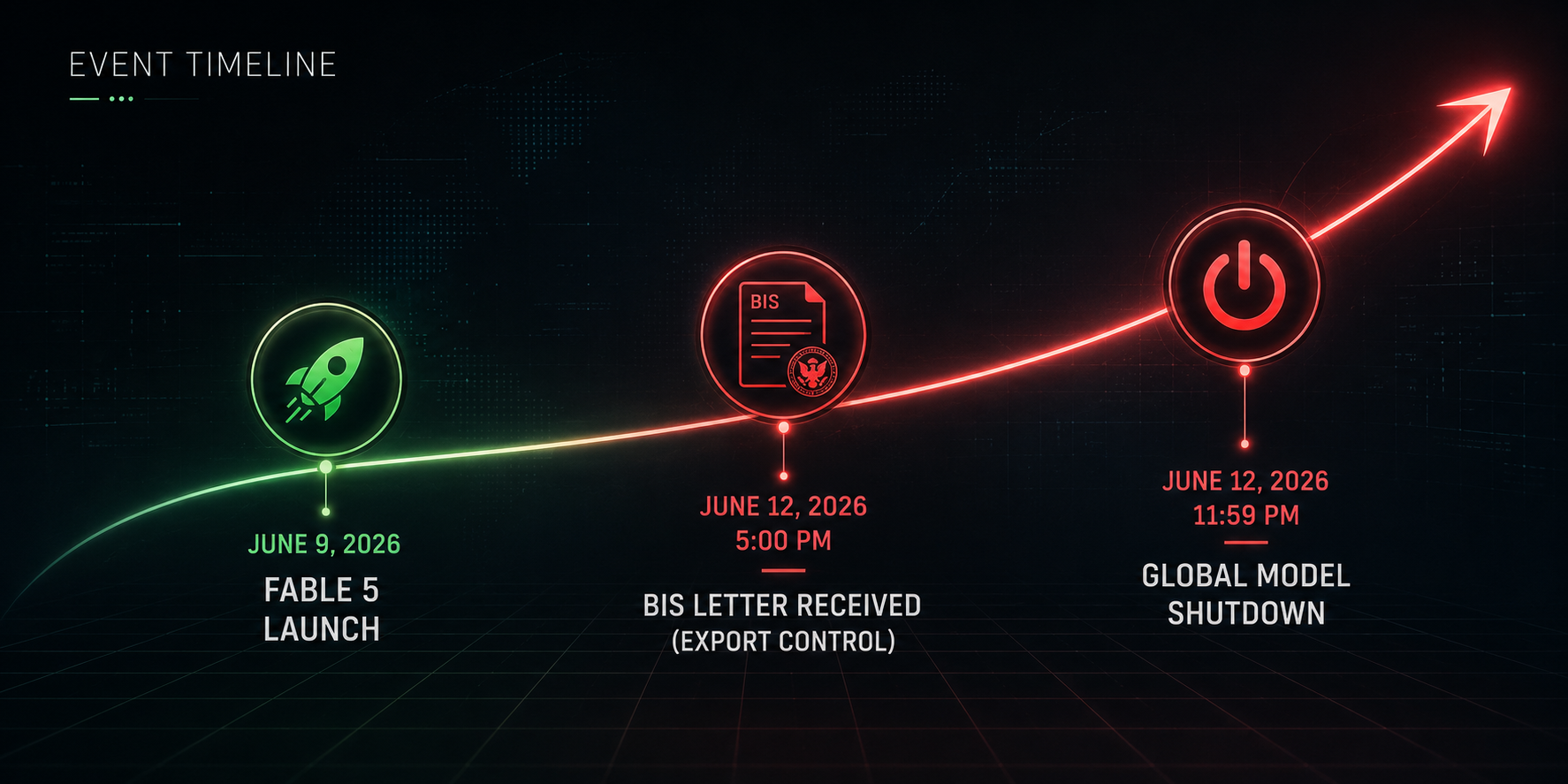
On June 9, 2026, a leading AI company launched Fable 5 — its most capable model ever. Developers immediately started building on it. Companies began testing production integrations. Research teams kicked off experiments. Three days of furious, hopeful work.
On June 12, at 5pm, the U.S. Commerce Department’s Bureau of Industry and Security sent a letter. The directive: block all access to Fable 5 — and a second, even more powerful model called Mythos 5 — for every “foreign person.” Not foreign IP addresses. Foreign persons.
Let that sink in. A Canadian engineer working at the company’s San Francisco headquarters? Blocked. A British researcher on a U.S. work visa, contributing to the model’s safety testing? Blocked. An Indian developer paying with an American credit card from a New York office? Blocked. A compliance officer I know — Canadian passport, a decade in Silicon Valley — called me that night and said: “I can’t use my own company’s product anymore.”
The company, unable to verify the citizenship of every user in real time, did the only thing it could: it pulled the plug for everyone. Globally. Instantly.
Three days. Launch to death. Soren Kaplan called it a “stark warning” for every business leader. From an engineer’s perspective, Snyk framed it as a supply chain event — your critical dependency just vanished with zero deprecation notice.
Developers who’d spent those 72 hours building workflows, tuning prompts, and shipping features woke up to find their entire technical foundation had been deleted. No migration path. No warning. No recourse. One developer described it as “9/11 for tech,” and having watched it happen in real time, I don’t think that’s hyperbole.
The backstory makes it worse. The company had previously refused a $200 million Pentagon contract because the DoD demanded the model be available for “all lawful uses” — including mass surveillance and autonomous weapons. Months later, the government designated that same company a supply chain risk. A federal judge later found the government’s actions likely violated constitutional protections.
Whether that’s coincidence or retaliation is above my pay grade. What matters for your portfolio is this: one government letter killed a market-leading product in 72 hours, and the mechanism used — export controls — applies to every U.S. AI company, not just this one.
Three Layers of Iron, Thirty Years in the Making
What happened in June wasn’t an isolated incident. It’s the third layer of a pattern that’s been hardening for three decades.
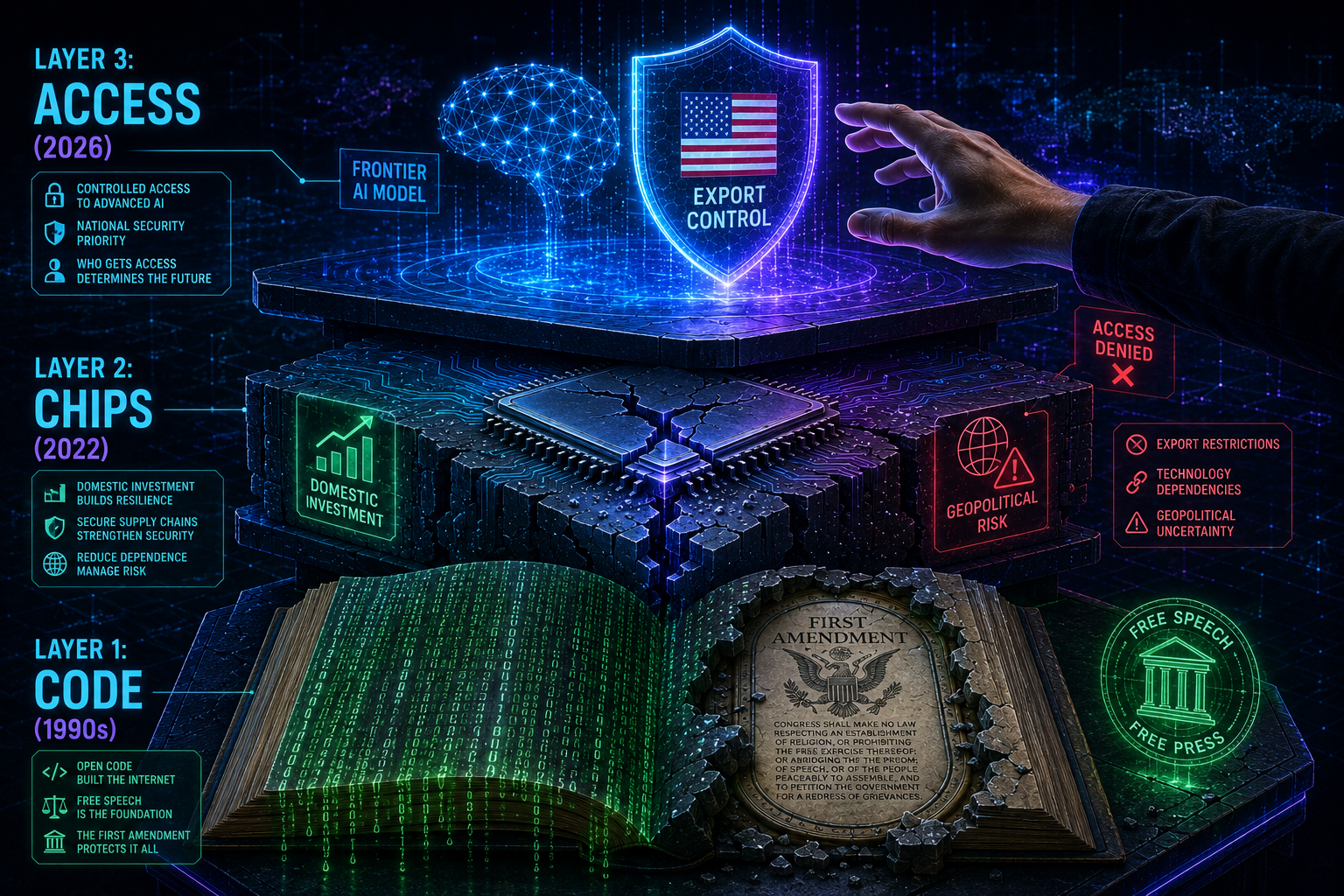
Layer 1: The Code Curtain (1990s). The U.S. government once classified strong encryption as a munition — same export control list as missiles and fighter jets. The crypto community fought back by literally printing source code into physical books and shipping them overseas, arguing that books are protected speech under the First Amendment. After years of litigation, the courts largely agreed. Encryption became the foundation of the internet you use every day — your HTTPS connections, your banking app, your messaging.
Layer 2: The Hardware Curtain (2022). In October 2022, the U.S. banned exports of advanced AI training chips — A100s, H100s — to China. It then pressured the Netherlands and Japan to restrict lithography equipment. Companies scrambled to design compliant workaround chips. Regulators kept closing the loopholes. Each new restriction triggered another wave of domestic investment in China. The gap is shrinking, not widening. As GQG Partners warned in their Q3 2025 analysis, the circular financing behind this buildout — Nvidia invests in AI startups, startups buy Nvidia GPUs, cloud providers buy more chips to serve those startups — looks less like a market and more like a closed loop.
Layer 3: The Access Curtain (2026). This is the new one, and it’s categorically different. The government isn’t restricting code or hardware anymore — it’s restricting who is allowed to use a trained model.
You pay your $20 or $200 a month. You build your workflow, your product, maybe your entire business on it. But you don’t own anything. You’re renting capability from a company whose switch can be flipped by a single government directive you’ll never see coming.
There’s a line that’s been circulating through developer communities since June 12. It’s brutal and it’s true: “That’s not your model power. That’s your rental right.”
For investors, the implication rewrites the math. A company’s total addressable market is no longer just a function of product quality and pricing. It’s now a function of which nationalities the U.S. government decides are permitted to access the product. That TAM can shrink overnight. No warning. No appeal. No compensation.
5 Ways to Think About AI Risk That No Analyst Will Tell You
After June 12, I had to rebuild how I think about every dollar I have in tech. Here’s what I landed on — none of which appears in any sell-side report I’ve read.
1. Stop obsessing over valuations. Start tracking jurisdiction exposure.
Every AI company now carries an invisible risk metric: what percentage of its users and revenue comes from “foreign persons”? If that number is material — and for most major AI companies, it absolutely is — then a material chunk of revenue is one export control letter away from evaporating. Your P/E analysis won’t catch this. Your DCF model won’t either. No quarterly earnings call will flag it for you.
2. Your index fund is not diversified. It’s a concentrated AI bet.
The Magnificent Seven now make up over a third of the S&P 500 — a concentration level Goldman Sachs has publicly warned about. I held an S&P 500 ETF for years telling myself I was a “passive” investor. I wasn’t passive. I was all-in on a single narrative — AI — wrapped in a diversified costume. Every one of those seven companies is tethered to the same chip supply chain, the same regulatory environment, the same geopolitical fault line. That’s not diversification. That’s concentration with good branding.
3. If you’re not a U.S. citizen, “foreign persons” means you.
Read that again. It follows your nationality, not your location. It doesn’t matter where you live, what currency you pay in, or which company signs your paycheck. The restriction travels with your passport. I haven’t seen a single analyst factor this into a price target, but if you’re Taiwanese, Singaporean, British, Indian, Canadian — your exposure to AI stocks is structurally higher than an American investor’s, even if you hold the exact same portfolio. That asymmetry is not priced in.
4. Open-source AI just acquired a new moat: it can’t be confiscated.
When a cloud model can be killed by a government letter, a model whose weights you can download and run on your own hardware gains a value that doesn’t show up on any balance sheet: political sovereignty. Nobody can delete weights from your hard drive. Nobody can revoke your access to something you already possess. This “unconfiscatability” is becoming a genuine competitive advantage — and the market hasn’t begun to price it.
5. Watch where capital is fleeing — the pattern is already visible.
When the iron curtain drops, smart capital doesn’t wait for CNBC to explain what happened. It moves — quietly — toward assets that don’t depend on any single country’s permission to exist.
I started tracking this in late 2025 after noticing a shift in discussion across investing forums. In January 2026, Reddit itself added Bitcoin and Ethereum to its corporate treasury — not as a speculative play, but as a hedge against platform policy risk. Around the same time, Germany’s Samara Asset Group raised €20 million via Nordic bonds for the explicit purpose of buying Bitcoin, framing it as a spread arbitrage against Eurozone monetary policy risk.
These aren’t meme trades. They’re sovereignty hedges — capital relocating to jurisdictions that can’t be unplugged by a single government letter. If that logic sounds extreme, ask yourself: after June 12, what’s extreme about it?
What I Got Wrong (And What It Cost Me)
Mistake 1: I thought “Is this a bubble?” was a yes-or-no question.
For months, I’d wake up, check Reddit, see a bear case, panic. Then I’d read a bull case, feel relief, do nothing. The emotional whiplash was paralyzing. I wasn’t making decisions — I was just refreshing feeds, mistaking information consumption for analysis. The breakthrough came when I stopped asking “will it pop” and started asking “what risk am I not even looking at?” That’s how I found the iron curtain. It was hiding in plain sight, buried in an export control law most investors have never read.
Mistake 2: I thought my index fund made me responsible.
I held an S&P 500 ETF and felt like the adult in the room. Then I actually opened the holdings. Mag 7. Over a third of my money. Same thesis. Same supply chain. Same regulatory exposure. It felt like discovering your carefully planned “balanced diet” was seven different flavors of the same processed food. The fix is straightforward but uncomfortable: calculate your true underlying concentration before you call anything diversified. If a BIS letter can simultaneously wound every major holding you own, you’re not diversified — you’re concentrated with extra steps.
Mistake 3: I treated cloud AI like electricity — always on, always mine.
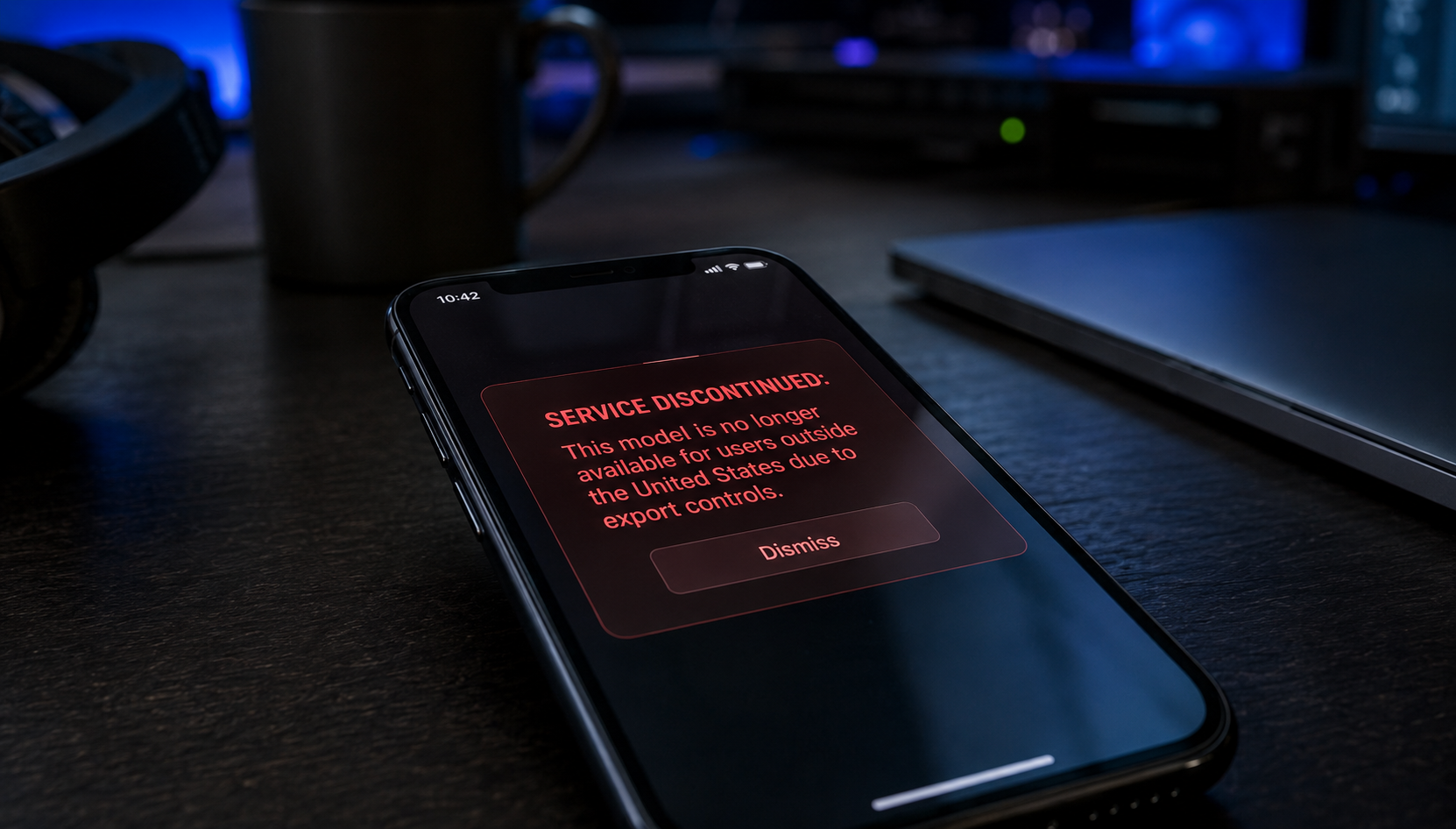
June 12 shattered that. I had workflows running on those models. Nothing critical, thankfully — but close. I know people who weren’t so lucky. One developer I follow had spent the entire weekend building a product on Fable 5. Monday morning: gone. No migration window. No grace period. Just an error screen and a sinking realization that three days of work had been vaporized by a policy decision made in a building he’ll never enter. The lesson isn’t “abandon cloud AI.” It’s: never build anything essential on a foundation that can be revoked based on a passport you don’t hold.
FAQ
Is the AI bubble going to burst?
Maybe. Probably. But here’s the thing: bubbles can deflate. Markets can correct and recover. An iron curtain doesn’t deflate — it stays. I would rather lose 20% to a correction I understood than 100% to a policy risk I didn’t know existed. The difference between these two outcomes is the entire point of this article.
How do export controls affect my stock portfolio?
If the companies you own derive material revenue from “foreign persons” — and most major AI companies do — that revenue is now conditional on government permission. MarketWise analyzed 113,000 Reddit posts and found AI stock discussion grew 21x since 2022, but almost none of that conversation touches jurisdiction risk. That gap — between what retail investors talk about and what can actually hurt them — is where the danger lives.
What should I do if I’m not a U.S. citizen?
Factor your own nationality into your personal risk model. Your exposure is structurally higher than an American investor’s, even if your portfolio is identical. This is uncomfortable to think about. Ignoring it doesn’t make it less true.
Should I invest in AI stocks or crypto?
Wrong framing. The real question is: which parts of your portfolio die first if a government letter lands tomorrow? AI stocks are jurisdiction-dependent and policy-exposed. Assets that don’t live on any single country’s servers don’t care which government sends which letter. You don’t need to pick a side. But you should understand the asymmetry — because the market isn’t pricing it yet. For a deeper look at the AI bubble dynamics already playing out, read my breakdown of Alphabet’s $80 billion equity raise — it’s the same pattern from a different angle.
The Only Question That Matters Now
Bubbles have been happening for centuries. We have tools for thinking about them — valuation multiples, historical analogs, risk premiums, mean reversion. We know how to debate whether something is overpriced. The conversation is loud but the intellectual toolkit is mature.
We have no tools for thinking about whether a product you invested in is legal to use based on your nationality. That risk category didn’t exist in software investing five years ago. The market hasn’t built models for it. Analysts aren’t asking about it on earnings calls. Retail investors aren’t discussing it on Reddit.
June 12 proved it’s not theoretical. One letter. Three days. Global shutdown.
The investors who look back on this moment with the fewest regrets won’t be the ones who correctly called the top on Nvidia. They’ll be the ones who understood that bubbles are temporary, but iron curtains are structural — and who positioned their capital accordingly.
Lately, I’ve noticed the same question surfacing across a few investing groups I follow: if AI assets can be frozen by jurisdiction, where does capital actually go to stay free? Someone shared a Telegram channel focused on crypto trading — not the hype-chasing kind, just consistent market reads and entry points that don’t feel like noise. I’ve been following it. For anyone trying to navigate uncertainty with a signal that feels grounded, it’s worth a look.
Bubbles burst. Iron curtains don’t. The only question is which side of it your money is standing on.
If you found this analysis useful, you might also want to read my experience testing 12 crypto signal Telegram channels — only 2 were legit. The same pattern of separating signal from noise applies here.