I Joined 12 Crypto Signal Telegram Channels — Only 2 Were Legit
Table of Contents
- What These Channels Actually Are
- Why Most Traders Get It Wrong (And Why I Started Testing)
- What a Real Signal Looks Like (Annotated)
- How to Spot a Legit Channel: The 5 Tests
- 5 Mistakes That Cost Me Money (So You Don’t Repeat Them)
- The 2 Channels That Actually Passed — and Why Style Fit Matters
- FAQ: Crypto Signals Telegram Questions
- Final Thoughts: Is It Worth It?
What These Channels Actually Are
A crypto signals Telegram channel is a group where a trader or team posts trade ideas — typically including the coin, entry price, stop-loss level, and take-profit targets — for subscribers to follow. Some are free. Some charge $30 to $150 a month for a “VIP” tier with more frequent or higher-conviction calls. The promise is simple: someone else does the analysis so you don’t have to stare at charts all day.
The reality is messier.
The Telegram crypto signal space is flooded with channels that look identical from the outside. Professional branding, daily posts, screenshots of winning trades. But behind a lot of that polish sits either a pump-and-dump operation or someone guessing and only showing you the calls that happened to work. I know because I’ve been on the wrong end of it — more than once. That frustration is exactly what pushed me to stop joining channels on impulse and start testing them systematically.
This article is not a list of channels to join. It’s the testing framework I built after burning real money — and it’s what finally let me separate the two legitimate operations I found from the ten that weren’t.
Why Most Traders Get It Wrong (And Why I Started Testing)
Most people don’t join a signal channel because they’re lazy. They join because they’re exhausted.
They’ve been checking charts at 2am, missing pumps while they sleep, revenge-trading after a bad loss, and watching their portfolio bleed in slow motion. At some point, the thought kicks in: “I just need someone reliable to tell me when to enter and when to get out.” That’s not weakness — it’s a rational response to an overwhelming market.
The problem is what happens next.
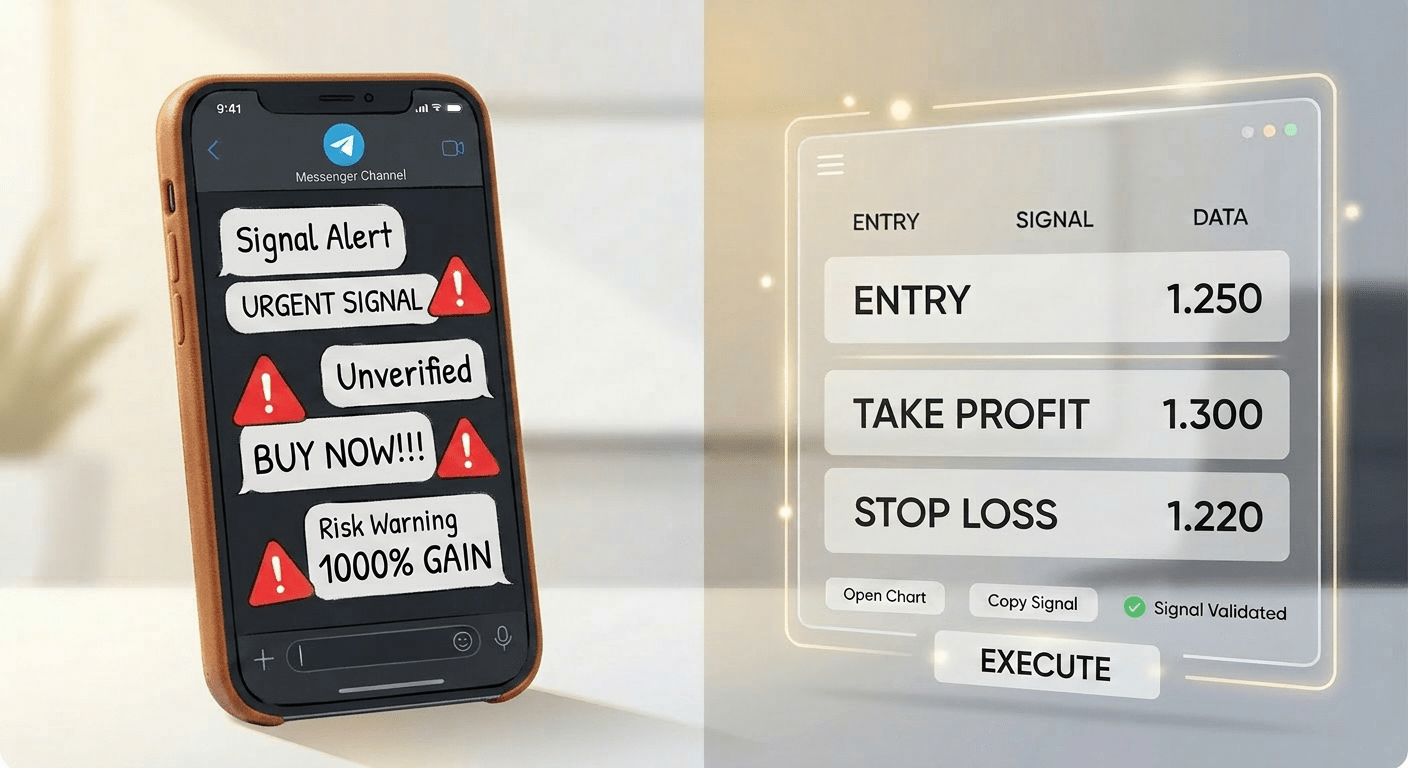
In my experience, the moment you start searching “crypto signals telegram,” you enter a minefield. The channels that spend the most on marketing are often the worst performers. The ones with the flashiest win screenshots frequently delete their losing calls. And the free groups? Some are genuine “try before you buy” funnels. Others are fronts where you are the product — liquidity for the admin to dump on. This isn’t hypothetical. In one well-documented case covered by CoinMarketCap, over $2 million was stolen from WallStreetBets members through a fake Telegram “crypto pumps” group. The scammers’ farewell message: “Buying lambo now.”
I learned this the hard way. My first paid signal group cost me $120 for the subscription and another $400 in bad trades before I realized the “analyst” had no methodology — just vibes and emojis. That $520 loss became the motivation for a 30-day experiment: I would join 12 different crypto signals Telegram groups — a mix of free channels, paid VIP tiers, and everything in between — and test every single one using the same framework. No exceptions, no shortcuts.
Only two passed. Here’s how I found them.
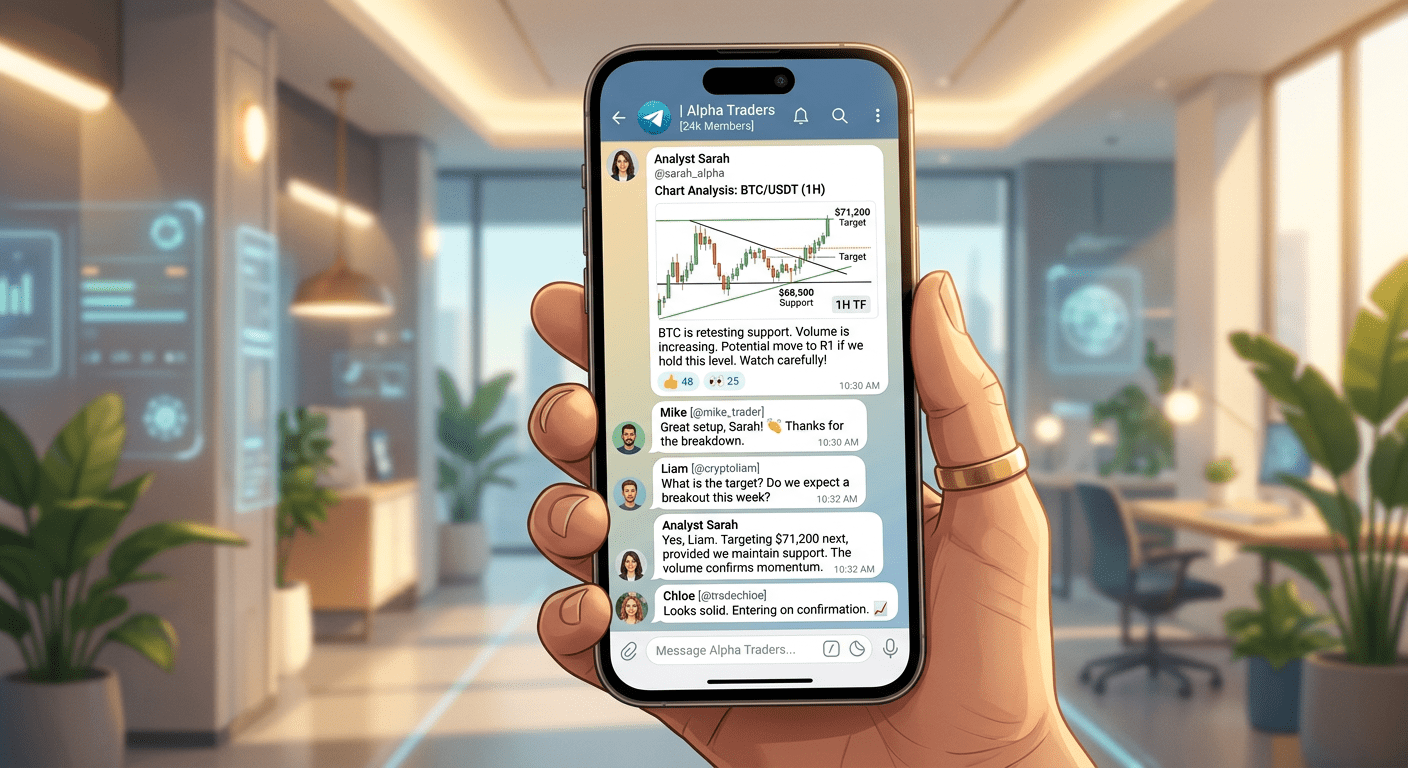
What a Real Signal Looks Like (Annotated)
Before we get into the testing framework, you need to know what you’re actually looking for. Most people evaluate channels by vibes — “the admin sounds smart,” “the screenshots look real.” That’s not evaluation. That’s hope.
Here’s what a properly formatted signal should include, every single time:
Entry price — The specific level where the trade should be opened. Not “around here” or “good zone.” A number.
Stop-loss — The price level where the trade is invalidated. This is non-negotiable. A signal without a stop-loss is not a signal. It’s a gamble with your name on the loss.
Take-profit targets — At least one, ideally two or three. A take-profit at the first resistance level, a second at the next, and sometimes a third for a runner position. This tells you the analyst has mapped the chart, not just picked a direction.
Timeframe — Is this a scalp on the 15-minute chart, a swing trade on the 4-hour, or a position trade on the daily? Without a timeframe, you don’t know whether to hold for 20 minutes or 2 weeks. That difference matters enormously for your stress level and your schedule.
Reasoning — One to three sentences explaining the setup. It doesn’t need to be a thesis. “BTC reclaiming daily support at 67k, confluence with the 50 EMA, volume confirming” is enough. The point is that it proves the analyst read the chart before they posted.
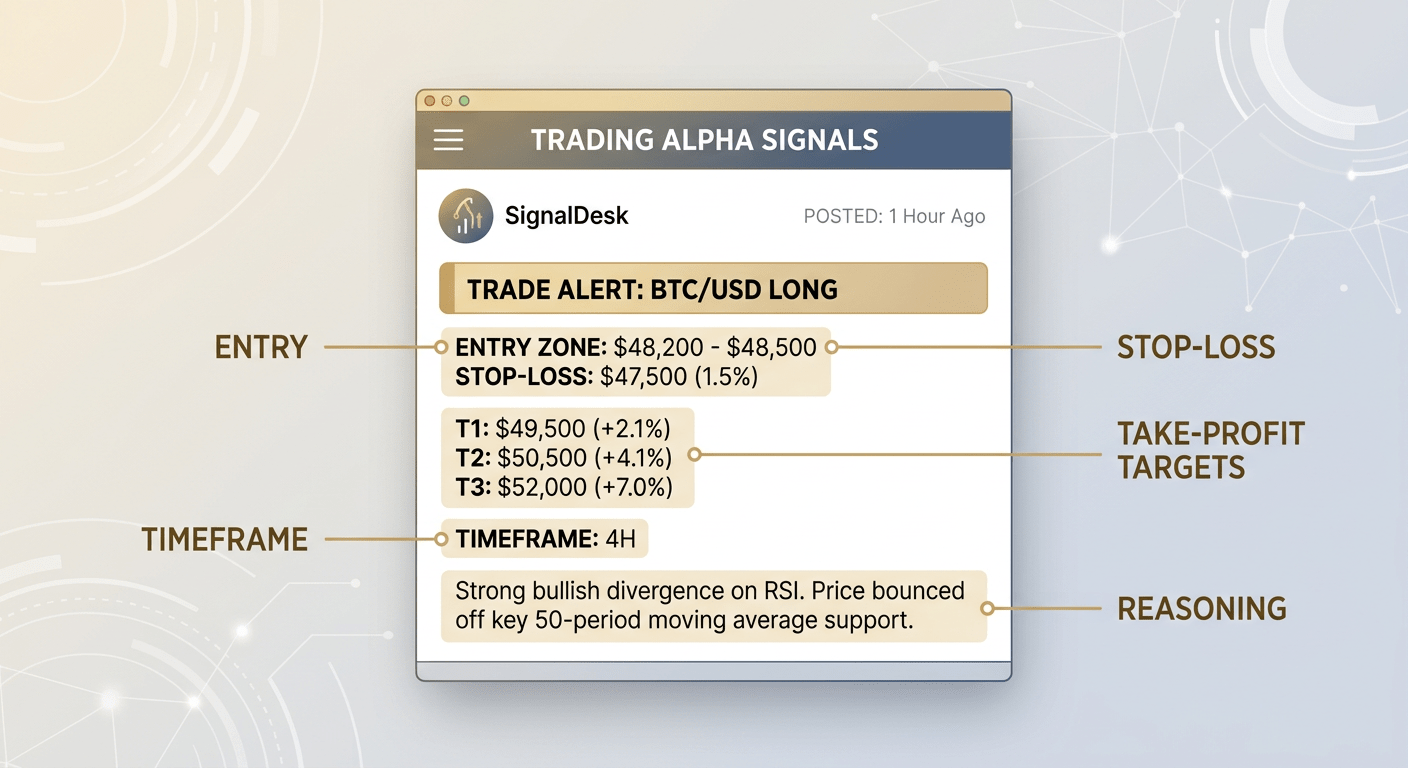
When I started testing channels, I built a simple scoring system. A signal got one point for each element present: entry, stop-loss, TP, timeframe, and reasoning. The best channels averaged 4.5 to 5 on every call. The worst averaged 1 to 2 — and those were the ones I’d once paid for.
How to Spot a Legit Channel: The 5 Tests
These are not theoretical. I used every single one across all 12 channels, and the ones that failed were eliminated immediately — no second chances, no “but the admin seems nice.”
Test 1: The Stop-Loss Question (Dealbreaker Potential)
This one test exposed more scammers than anything else I tried. Send the channel admin a direct message and ask: “What percentage of your account do you risk per trade, and where was the last stop-loss you personally hit?”
A genuine trader answers immediately. They’ll say something like “1-2% per trade” and can point to a specific recent loss — what coin, what level, what happened. Real traders lose. They just lose small.
A scammer deflects. They’ll say “our signals never hit stop-loss” or change the subject entirely. If someone claims a 90%+ win rate with no losing trades, they’re either lying or not using stop-losses — and either way, walk. Of the 12 channels I tested, 7 failed this question within the first 48 hours.
Test 2: The Paper Trade Mandate (The Real Dealbreaker)
If there’s one test you never, ever skip, it’s this one. Never join a paid tier without paper-trading the free channel’s calls for at least two weeks. Open a spreadsheet. Log the entry price, exit price, whether the signal had a clear stop-loss and take-profit, and the P&L result. At the end of two weeks, the data decides — not the marketing, not the hype, not your FOMO.
A legitimate channel encourages this. One of the two that passed told me flat-out: “Trade our free calls on paper for a month. If the numbers work for you, the paid tier will still be here.” That’s confidence backed by transparency. If a channel uses urgency tactics instead — “price is about to pump, join VIP now or you’ll miss it” — that urgency is designed to bypass your judgment. Don’t let it. Four of the 12 channels failed here.
Test 3: The “Why This Coin?” Litmus Test
Every signal should come with a reason. Not a novel — a sentence or two. “BTC long at 67k — reclaiming daily support, confluence with the 50 EMA, SL below the swing low at 66.5k.” That tells me the analyst read the chart.
If every signal is just “BUY X COIN NOW 🚀” with no reasoning, no stop-loss, and no exit plan — you’re following a gambler, not a trader. The difference matters because gamblers eventually go broke, and when they do, your account goes with them.
Test 4: The Human Behind the Channel
Before I trust any channel with real money, I want to see the person behind it. Do they have a Twitter account with original analysis going back months? A LinkedIn? A face? Anonymous channels are the highest-risk category because they can burn their entire reputation and rebrand under a new name in 24 hours. There’s zero accountability, and they know it.
Of the 12 channels I tested, the two that passed both had identifiable, verifiable people behind them — one was a solo trader with an 18-month public Twitter history of market commentary that matched his signal reasoning; the other was a small team of three who traded their own capital and posted their personal P&L alongside the signals.
Test 5: The Win Rate Sanity Check
Anyone claiming above a 70% win rate without third-party audited proof is suspect. Even the best trading firms in the world operate in the 50-65% range. A legitimate provider talks openly about their losses and drawdowns — because those losses prove they manage risk, not hide from reality.
If the public channel only ever shows green trades, ask yourself: where are the losses? Every real trader has them. One of the two channels that passed had a pinned message titled “Monthly Performance — April 2026” that included the win rate (61%), the total P&L, the largest drawdown, and a short note about what went wrong on the worst trade. That single post told me more than 10,000 rocket emojis ever could.
For additional detail on evaluating providers, the Pulse.com.gh checklist covers some complementary ground — but the five tests above are the ones I actually used, and they’re the ones I’d bet on.
5 Mistakes That Cost Me Money (So You Don’t Repeat Them)
Mistake #1: Joining a Paid Group After 3 Green Calls
This one hurt. A free channel posted three winning trades in a row — clean entries, clean exits. By the third win, my FOMO was screaming. I paid $120 for the VIP tier that same day. Within a week, the “premium” signals had lost me another $300. The three wins that sold me? Random. I had no sample size, no spreadsheet, no proof — just excitement. The sinking feeling when you realize you paid to lose money is humiliating. I felt like a mark.
The fix: mandatory two-week paper-trade test, every time, no exceptions. Three trades is noise. Fourteen is the beginning of a sample.
Mistake #2: Following a Signal With No Stop-Loss
One of the channels I tested — with over 70,000 members — posted a trade with an entry price and nothing else. No stop-loss, no take-profit, just “buy now.” I entered anyway. The trade went against me fast. I held, refreshing the chart every 30 seconds, telling myself it would reverse. It didn’t. A small loss became a deep drawdown before I finally closed it, exhausted and embarrassed.
The Vice journalist who infiltrated the “Big Pump Signal” group documented this exact pattern: organizers pre-accumulate a coin, pump it to followers, then dump their bags while everyone else holds the loss. He turned £100 into £8 in four minutes. The mechanic hasn’t changed in years because it keeps working.
The fix: never enter a single trade without a hard stop-loss. If the signal doesn’t provide one, set it yourself — 1-2% below a key support level. If a channel consistently sends signals without risk management, leave.
Mistake #3: Believing the 93% Win Rate Claim
I joined one channel purely because their pinned message claimed a 93% win rate with dozens of green trade screenshots. It took me three weeks to notice the losses were simply never posted. One day a losing call would appear in the feed; the next morning, gone. What tipped me off was a specific ETH short that got stopped out at a $400 loss on a Tuesday — I saw it, felt the sting, closed my own position. When I checked the channel Wednesday morning to see if they’d addressed it, the message was gone. No acknowledgment, no update, just erased. That’s when I started screenshotting every signal myself. Within two weeks, my archive proved the real win rate was closer to 45%.
The feeling is betrayal mixed with bitterness. You feel like a fool — and the worst part is, some part of you knew it was too good to be true. You just wanted it to be real.
The fix: demand proof, not promises. A third-party audited track record, a public trade log that can’t be edited after the fact, or your own two-week paper-trade spreadsheet are the only forms of evidence that count.
Mistake #4: Taking Every Single Signal
One channel I tested posted 5 to 7 signals per day. I took them all — 8 positions open simultaneously, monitoring everything, stressed out of my mind. I hadn’t solved my anxiety problem. I’d just outsourced it to someone else’s volume game.
The moment that made me stop: I was sitting in a meeting at my day job, phone under the table, checking three positions on the 5-minute chart while pretending to pay attention. I was doing exactly what I’d done before signals — obsessing over charts — except now I was following someone else’s trades instead of my own, which somehow felt worse. I’d swapped one addiction for another.
The fix: a quality channel posts 1-3 high-conviction calls per day at most. Any more than that is spraying and praying — volume for the sake of looking active. Pick channels that trade less, not more.
Mistake #5: Staying Dependent Forever — Never Learning
For months, I blindly copy-traded without ever asking why a setup worked or failed. I was a passenger, not a pilot. When one channel went quiet for two weeks, I was right back where I started — unable to trade on my own, scrolling Twitter for the next signal group like an addict looking for a new dealer. The dependency was the real cost, not the subscription fee.
The fix: for every signal you follow, write the rationale in your own words. After 30 signals, you’ll notice patterns. After 100, you’ll start recognizing setups without being told. Use signals as training wheels, not a permanent crutch.
The 2 Channels That Actually Passed — and Why Style Fit Matters
Of the 12 channels I tested, only two passed all five tests. I’m not naming them here — that’s not the point of this article, and honestly, what works for me might not work for you. But I’ll describe what they looked like so you know what to recognize when you find your own.
Channel A was a solo trader with an 18-month public track record. He posted 1-2 signals per day, swing trades on the 4-hour and daily charts, with full entry/stop-loss/take-profit formatting and a short reasoning paragraph on every call. He answered my stop-loss question in under 10 minutes with a specific trade from the previous week where he’d been stopped out of a BTC long. His win rate? 61% over the trailing 6 months — and he was the first to tell you that.
Channel B was a three-person team trading their own capital. They posted their personal P&L weekly alongside the signals. They traded less frequently — maybe 8-10 signals per week — and focused on higher-conviction setups. They had a channel rule: no signals on Sundays, and anyone asking for signals on Sundays got muted. I respected that more than I can explain.
Here’s the thing neither channel taught me directly — but both made obvious in hindsight: style fit matters as much as legitimacy. Channel B, for all its transparency, traded mostly altcoin pairs with higher volatility and wider stops than I was comfortable with. I paper-traded their calls for two weeks and the win rate was solid, but the drawdown swings were keeping me up at night. That’s not the channel’s fault — their risk parameters worked for them. They just didn’t work for me.
Before you commit to any channel, even a legitimate one, ask yourself: does the trading style match your schedule, your risk tolerance, and your emotional bandwidth? A scalping channel that posts 10 signals a day might be perfectly legitimate and still destroy your mental health if you have a full-time job. A swing trading channel with 3 signals a week might be exactly right — even if it’s less exciting.
I passed on Channel B. Not because it was bad, but because it was bad for me. That distinction alone is worth more than any win-rate claim.
FAQ: Crypto Signals Telegram Questions
How do I know if a crypto Telegram signal channel is legit or a scam?
Look for five things: (1) a verifiable track record of at least 3-6 months showing both wins and losses, (2) every signal includes entry, stop-loss, and take-profit with reasoning, (3) a transparent person or team behind it — not an anonymous account, (4) community feedback on Reddit or Trustpilot that includes both praise and criticism, and (5) no pressure tactics or “limited spots” urgency. If three or more of these are missing, proceed with extreme caution. If the channel won’t answer a direct question about their last stop-loss, that’s a dealbreaker — move on.
Are free crypto signals on Telegram worth using?
Free signals can be worth your time — but only if the provider is transparent and you paper-trade the calls before committing real money. The best free channels function as “try before you buy” funnels for a paid service, and that’s fine as long as the results are unedited. The real danger is free channels that are fronts for pump-and-dump operations where followers are the exit liquidity. Test everything.
What’s the difference between a pump-and-dump group and a real signal channel?
Real signal channels provide reasoning, stop-losses, take-profit levels, and a track record that includes losses. Pump-and-dump groups announce a coin at a specific time with no exit strategy, hype it with “moon” language and rocket emojis, and the price crashes within minutes as the organizers dump the bags they quietly accumulated days earlier. If there’s no exit plan in the signal, assume you are the exit plan.
How much should I pay for crypto trading signals?
Most legitimate services charge $30 to $150 per month for a premium tier. Be suspicious of anything above $200 per month without a long, verifiable, audited track record. Also be wary of one-time “lifetime” fees — honest services earn money from ongoing subscriptions, not one-off cash grabs.
Can I make money following signals, or should I learn to trade myself?
You can make money following quality signals. But the best outcome — the one I recommend to everyone who asks — is to use signals as a learning tool while you build your own skills over time. Follow the signals, study why each one worked or failed, and gradually develop the ability to spot your own setups. The goal is to need fewer signals, not more.
Final Thoughts: Is It Worth It?
After 30 days inside 12 different crypto signals Telegram channels, here’s my honest take: there are good ones out there — two, in my case. They’re outnumbered by bad ones by a ratio of about 5 to 1, and most of the bad ones are designed to look exactly like the good ones. That’s the game.
Your best defense is not a list of channels to trust. It’s a methodology that makes you impossible to fool. Paper-trade first. Ask the stop-loss question. Demand reasoning on every call. Verify the human behind the screen. And never forget that even a legitimate channel might not be right for your style — a channel can be honest and still be a bad fit.
If you’re tired of doing all this research yourself — of digging through channels, second-guessing screenshots, and wondering which ones are worth your time — I keep my own analysis free and open. My public channel posts daily market breakdowns with trade ideas when the setup is right. The bot auto-approves you in seconds — no payment, no catch. You can join, paper-trade the calls for two weeks, and decide with your own data.
If the format works for you, the signal channel offers a free trial — same zero-friction approach, same bot-driven instant access. No credit card, no pressure, no “limited spots” countdown. Just test it yourself and let the numbers decide.
At the end of the day, that’s the only system that protects you. Don’t take anyone’s word for it — not mine, not theirs. Test. Track. Decide. That’s the framework that cost me $520 to learn, and it’s the one I still use every time.
Ready to Take the First Step?
Join our community for daily market news. Curious about our strategy? Preview 8-15 daily short-term trade setups in the Signals channel — new users who join via the "Trade Signals" button automatically receive a $59/month pass. Prefer a personal conversation? Contact us anytime.