

Midea Stock: Europe’s Heatwave Sellout Meets a 5% Short — What Now?
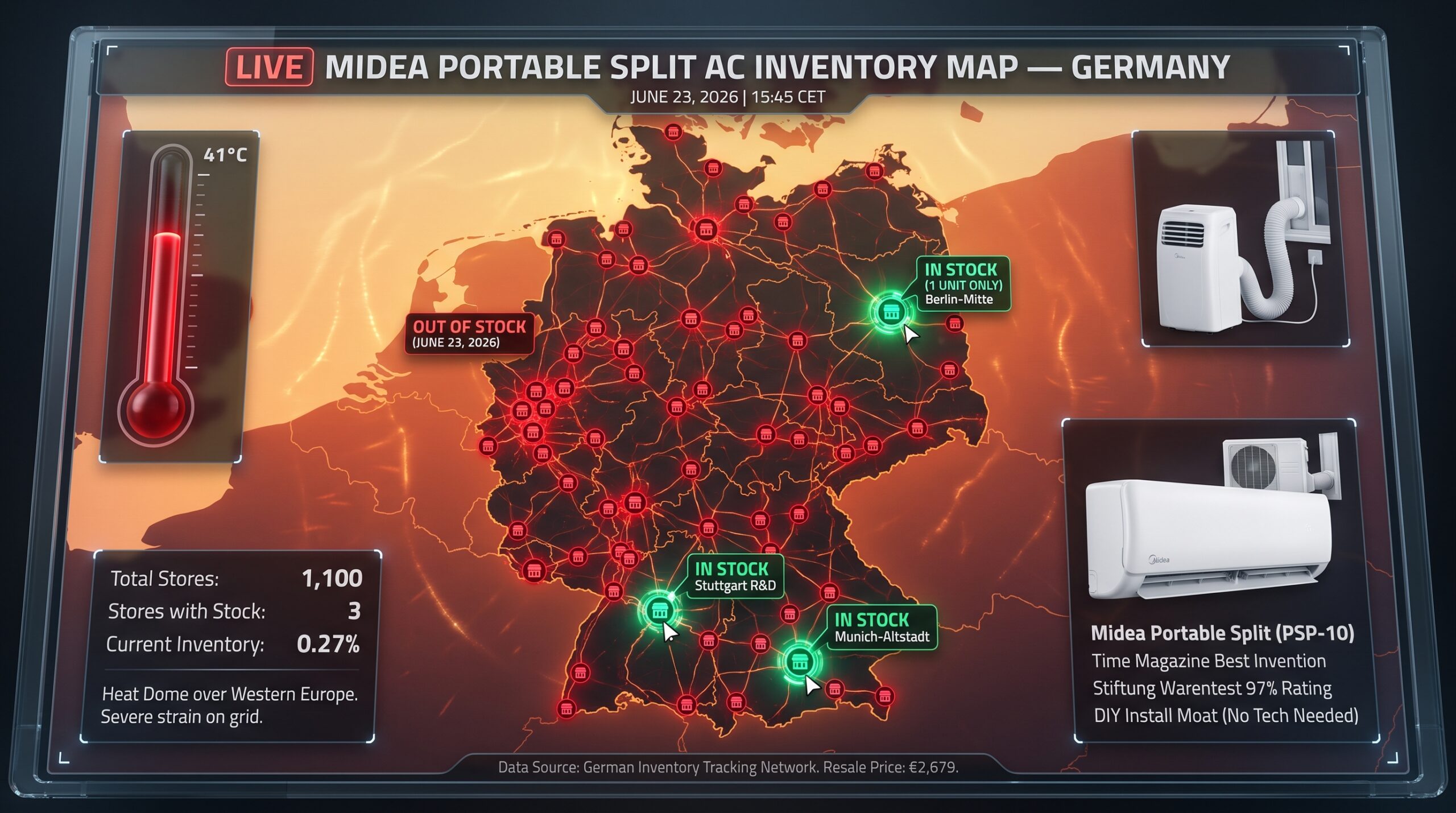
A German programmer built a website tracking real-time inventory of one air conditioner across every electronics store in the country. On June 23, the map went red — 1,100 stores, three had units left. People drove 200 kilometers across provinces chasing the last box. On secondary markets, a €900 Midea Portable Split changed hands for €2,679. Someone listed it for rent at €350 per week. Scammers even spun up AI-generated ads for fake knockoffs called “BREASO MAX” to cash in on the frenzy.
The same week, midea stock dropped over 8% in a single session. JPMorgan had just raised its short position to 5.15%. Shenzhen-Hong Kong Stock Connect showed 1 billion yuan in net selling.
Product selling out everywhere. Stock getting hammered. When I first saw the sellout numbers, my finger was literally hovering over the buy button. Then I pulled Midea’s last two quarterlies — and put the phone down. Here’s what I found on both sides.
📋 Table of Contents
Why Europe’s 2026 Heatwave Broke the System
The europe heatwave 2026 was driven by a heat dome — a high-pressure system parked over Western Europe like a lid, trapping hot air underneath. Scientists say this pattern used to occur once every 300 years. Now it’s showing up less than a decade apart, with an emerging El Niño threatening to make next summer even worse. Railways shut down from track expansion. French nuclear plants cut output because river cooling water ran too warm. Italian cities experienced blackouts from AC-driven power surges. Over 1,300 heat-related deaths were recorded in one week. Air conditioning reduces heat mortality risk by roughly 75%.
So why don’t Europeans just buy ACs? Because most of them literally can’t.
Paris and Rome block facade drilling under heritage protection laws. Spain requires 60% building-owner approval for any outdoor unit. Germany caps nighttime noise at 35dB. France mandates a licensed technician for any AC with over 2kg of refrigerant. Berlin is nearly 80% renters — modifying walls isn’t even an option. And even if you clear all that, good luck finding an installer: Europe has a critical HVAC technician shortage, with wait times of four to six weeks during heatwaves and installation fees of €1,000–2,000 — often more than the unit itself.
The cultural resistance to AC — long seen as an American indulgence, anti-green, unhealthy — is finally crumbling under the weight of dead bodies. A London mother interviewed this summer put it bluntly: anyone who’s ever tried to put a baby to sleep in a heatwave should go buy an AC right now. That shift, once it happens, doesn’t reverse. You don’t un-install an AC when next summer comes.
The Bull Case: A 145-Million-Unit Gap With a Regulatory Moat
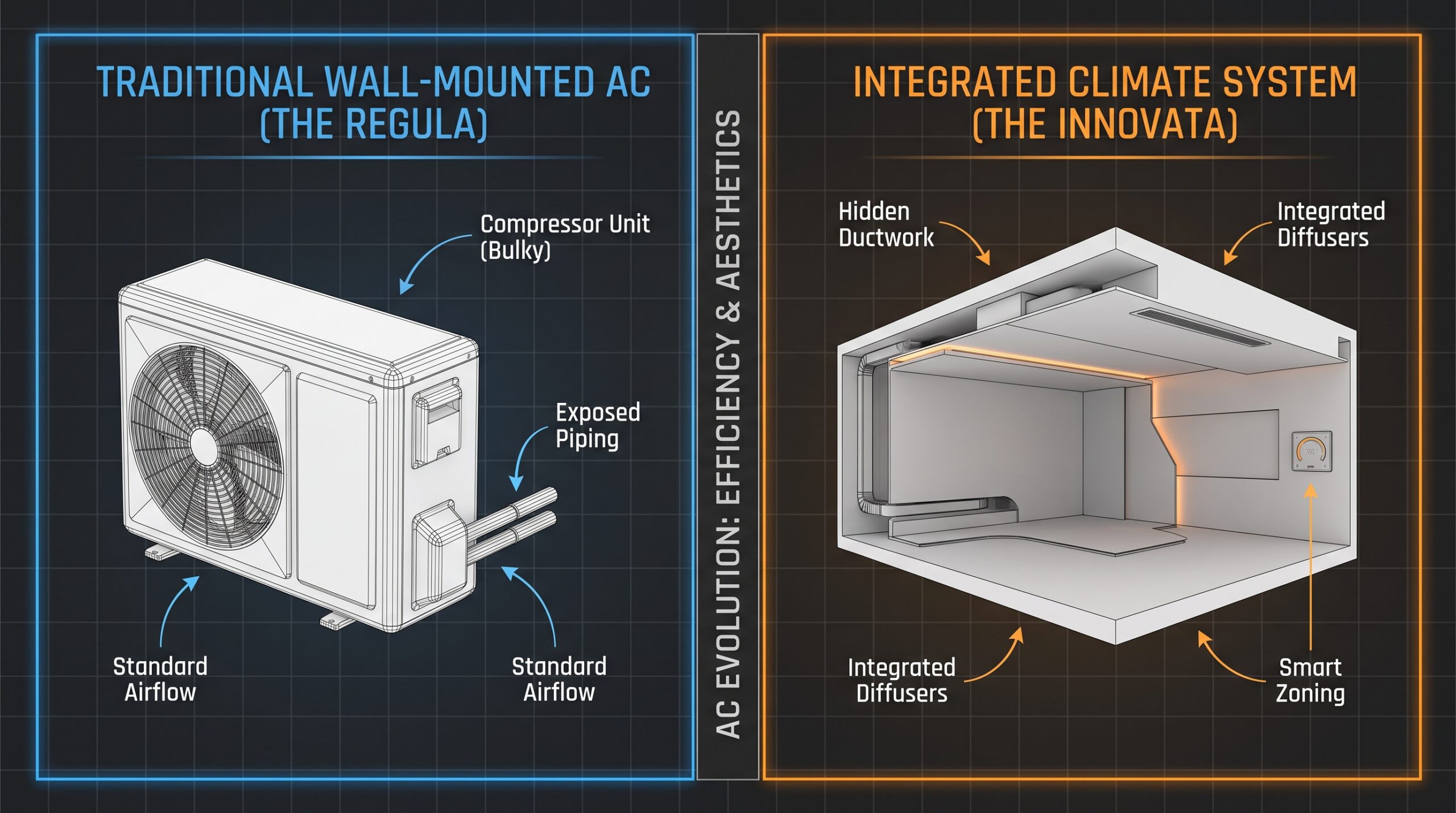
Midea’s Portable Split didn’t fight Europe’s regulations. It made every trigger condition irrelevant: 10kg outdoor unit on a window bracket (no drilling, no facade changes, fully reversible for renters), 1.99kg refrigerant (just under France’s 2kg technician threshold), 35dB silent mode (exactly at Germany’s limit), three-step DIY install (no technician visit needed). Designed from scratch at Midea’s Stuttgart R&D center — a dedicated European team studying 27 different national building codes, window types, and rental-market constraints. Not a Chinese model shipped over with a translated manual.
The moat isn’t just the product design. Midea’s Portable Split won Time Magazine’s Best Invention award and scored 97%+ from Germany’s Stiftung Warentest — the highest rating ever for a mobile AC. The product achieved this without spending millions on European TV ads or celebrity endorsements. Instead, consumers built the inventory-tracking website themselves. Users started posting their purchases like lottery wins in online forums. When a brand enters a market through word-of-mouth rather than advertising, the trust compound is fundamentally different. Midea is also pricing at €900–1,200 — premium territory — which largely insulates it from EU anti-dumping actions that target low-price OEM goods.
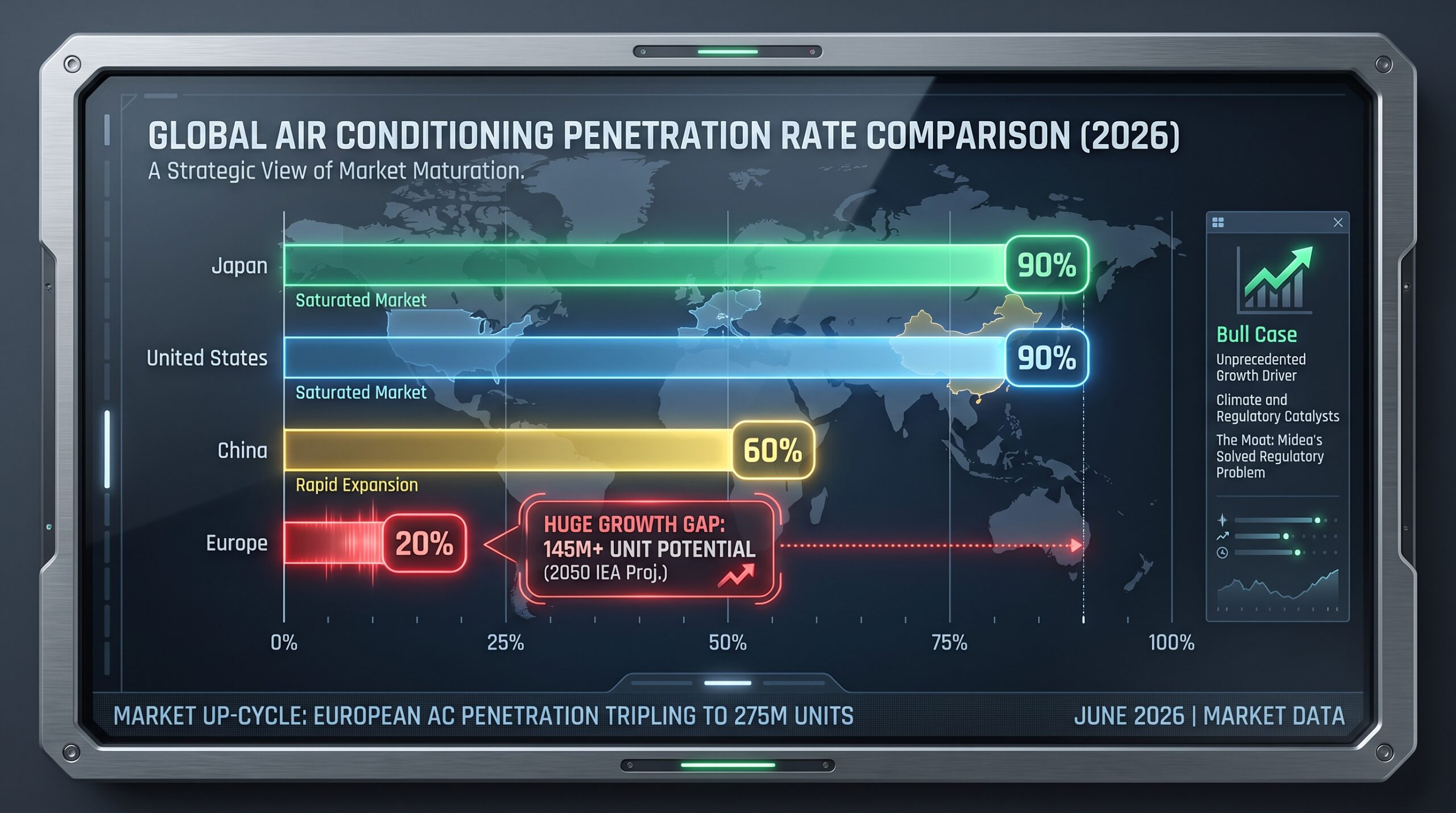
The IEA projects Europe’s AC installed base to triple from roughly 130 million units to 275 million by 2050. Europe produces only 3.2 million units domestically per year against demand already exceeding 10 million. Midea has been acquiring European distribution — Clivet in Italy, Arbonia’s climate division — while scaling its own-brand overseas revenue to over 45% of international sales. This isn’t the old OEM playbook of “make it in Guangdong, slap on someone else’s logo.” Midea’s brand is now the one Europeans search for.
Citi Research issued a Buy rating on June 30 with a 126.3 HKD target, calling European AC penetration a “multi-year upcycle.” Midea’s H1 2026 European AC sales surged over 70% YoY, with Spain and France shipments jumping 108%. The stock trades at roughly 13x earnings with a 5.5% dividend yield and a 100% shareholder cash return commitment for 2026.
On climate investing: this isn’t about ESG funds or carbon credits. It’s about which company solved a regulatory problem 27 different national building codes created — and built the product that finally lets Europeans survive their summers.
The Bear Case: Why JPMorgan Is Short
JPMorgan raised its short to 5.15% on June 24 for specific, verifiable reasons. Midea’s Q4 2025 core (adjusted) net profit fell 23.1% year-over-year, and Q1 2026 fell another 14.02%. Operating cash flow dropped 11.84%. Return on invested capital eroded from 23.95% in 2016 to just 15.50% in 2025 — dragged down partly by Kuka robotics, which still contributes only 6.79% of revenue despite years of investment.
Selling 200,000 Portable Splits in Europe is a great story — but Midea’s annual revenue is 456 billion RMB. The bears argue the European demand is a rounding error propping up a deteriorating core.
On midea vs gree: Citi gives Midea the edge for European exposure — Gree’s overseas revenue is only ~15% of total. But both face the same China home-market profit pressure. Picking between them isn’t about European AC sales. It’s about whose domestic business stabilizes first.
The Trap I Almost Walked Into
When the Portable Split sellout hit my feed, I almost bought immediately. The narrative was perfect: structural demand, regulatory moat, 3x secondary pricing, word-of-mouth brand building that money can’t buy. What stopped me was a rule I built after getting burned too many times: never enter a trade within 24 hours of reading the headline.
I used those 24 hours to read the quarterlies. That’s when I found the core profit decline. That’s when I saw the ROIC erosion. That’s when I found JPMorgan’s 5.15% short. None of this made the story wrong — the penetration gap and the regulatory moat are real. But it made my entry timing wrong. By the time a story reaches viral status, institutional money has usually already positioned. JPMorgan didn’t wait for the heatwave — they built their short before the news peaked, then added as retail piled in.
The 24-hour rule won’t make you right every time. But it’ll stop you from being someone else’s exit liquidity.
Final Thoughts
I don’t think this is a one-summer story. The penetration gap, the regulatory moat, the installer shortage, and the cultural shift toward AC acceptance are all structural. But JPMorgan’s core-profit concerns are also structural — one hot summer won’t fix declining ROIC or a Kuka division that’s been burning capital for years.
This is a trade with legitimate cases on both sides, which is rare and worth attention. Resolving contradictions like this — where the product story says one thing and the financials say another — is what separates analysis from gambling. If you want more honest breakdowns like this, where the bull and bear case both get a fair hearing, a few friends run a Telegram channel sharing stock trading signals and trade research on setups most people miss: https://t.me/+kSMilTpNdcZlNjYx
FAQ
Is Midea stock a good buy right now?
I don’t give buy/sell recommendations. Midea trades at ~13x earnings with a 5.5% dividend yield and a 100% shareholder cash return commitment. Citi rates it a Buy at 126.3 HKD. But core profit has declined for two straight quarters, and JPMorgan’s 5.15% short signals genuine concern. The bull case lives or dies on whether European AC penetration growth outpaces domestic margin erosion.
Why did the stock drop when the product is selling out everywhere?
Three factors: (1) Core profit deterioration in Q4 2025 (-23.1%) and Q1 2026 (-14.02%) spooked institutional holders, (2) JPMorgan raised its short to 5.15% on June 24, (3) the heatwave headlines may have been a “peak positive” — good news already priced in, giving funds an exit window. The 8% single-day drop wasn’t random. Institutions sold into retail enthusiasm.
How is Midea different from Gree or Haier for European exposure?
Midea has the largest HVAC exposure to Europe among Chinese appliance makers. Its Portable Split was designed at a dedicated Stuttgart R&D center for European regulations, window types, and rental-market constraints. Midea has acquired European players like Clivet and Arbonia’s climate division for local distribution. Gree’s overseas revenue is ~15% of total with limited European own-brand contribution. Citi’s top pick is Midea.
Could a mild 2027 summer kill this trade?
A mild summer would cool demand temporarily, but the penetration gap (20% vs 90%) and building regulation problems are structural — not weather-dependent. The bigger risk: competitors (Gree, TCL, Haier) launching similarly designed no-drill units within 12-18 months, narrowing Midea’s regulatory first-mover advantage. The moat isn’t permanent. It’s a head start.
What should I watch next on Midea stock?
Q2 2026 core (adjusted) net profit. If it stabilizes after two consecutive quarterly declines, the bull case gets oxygen. If it drops again, the bear case strengthens regardless of how many Portable Splits sell in Europe. The earnings report is expected in late August.